Showing posts with label book review. Show all posts

Monday, May 11, 2009

The Brass Verdict (2008) by Michael Connelly


This is not so much a book review as it is a WARNING. The Brass Verdict is without a doubt or hesitation the most disappointing novel I’ve read by Michael Connelly—and I have read them all. The plot is plodding and quite boring. The conclusion is anticlimactic. Mickey Haller as main character and narrator is not nearly as appealing as he was in The Lincoln Lawyer. For most of this novel, he seems like a dime-a-dozen defense lawyer, in it for the money and the fame, giving lip-service to justice and the merits of the US court/trial system. Harry Bosch comes across as a stereotype of the tough and ruthless LA Homicide Cop, not at all the complex “I speak for the victims” force of other novels. Every time I picked up this novel, I wished it was over. Please, please, please don’t let this be your first Connelly novel, because with the exception of this novel, Michael Connelly is the best crime writer in America. I can’t imagine how this endeavor went so terribly wrong.

Saturday, May 09, 2009

How to Enjoy Writing: A Book of Aid and Comfort by Janet and Isaac Asimov


How to Enjoy Writing: A Book of Aid and Comfort by Janet and Isaac Asimov

If you’re looking for a book to help lift your writing to new heights, this is NOT it. However, if you enjoy writing and enjoy reading about writers and their opinions about the writing process and why writing matters, this little book might very well delight you as it did me.

Wednesday, March 25, 2009

Book Review: Paper Cathedrals (2001) by Morri Creech


Since my undergraduate college days, I’ve been enamored by intersections between art/literature and Christianity. It’s especially powerful when, whatever the medium, the artist/writer avoids being preachy or maudlin and succeeds in engaging Christian motifs in a strikingly thought provoking way. In Morri Creech’s poetry collection Paper Cathedrals, I discovered exactly that kind of stimulating engagement with biblical materials.

In “Honey and John the Baptist,” Creech imagines an internal monologue for John the Baptist. John has completed his preordained purpose of preparing the way for Lord and simply waits in a state of purposelessness:

. . . the crowds had gone,
what work was I left to do,
having set it all in motion, . . .

No longer the chosen . . .

Creech’s poems often probe those afterward and in-between moments of New Testament events, the Bible’s “deleted scenes.” These are shown to be moments of weakness, sorrow, and/or regrets.

In his impotency, John the Baptist reflects not only on his own coming death, but also on the temptations and coming death of Jesus:

And weren’t the long beams of the cross
already hewn from the tree,
Salome’s young thighs
ripening toward the dance
as I ate of the honey,
as I tasted the scald of bees
drowned in the chambered sweetness
of their own making?

Not all the poems here are biblically based. Several are responses to photographs and a few seem to be familial poems. However, the most stirring and even somewhat disturbing poems are those written from the point of view of Judas, the betrayer.

Creech’s poems give us a hugely sympathetic Judas, a disciple in love with his master, devoted, and intimately a part of the inner circle. Vividly the poems retell familiar scenes which are made new through showing them from Judas’ point of view alone. There’s an added dimension of pain when we know in advance that the speaker is headed toward betrayal and destruction.

Without a doubt, the most striking poem of the collection is one entitled, “The Room Reserved for Judas” where Creech imagines in acute detail the living quarters that were set aside for Judas in heaven but were never claimed.

There are no pictures arranged
on the mantelpiece, no flowers pressed
in the pages of the a family Bible. The door
remains numberless. . .

Yet even there, in the far corner of the kingdom,
one can still hear God’s loud voice
and the trumpets of mercy . . .

As the heavenly sounds penetrate this empty room, the poem conveys a haunting sadness of loss and disappointment. One of God’s children, chosen by Jesus to be his disciple has fallen away. He will never come into his inheritance. It’s a chilling poem.

Paper Cathedrals is an astounding collection.

Tuesday, March 24, 2009

Book Review: Barnstomer in Oz (1982) by Philip Jose Farmer


Have you ever wondered what would happen if a World War I veteran accidentally found himself in the land of Oz just as Oz was entering a major war itself? I doubt you ever have, but if you had this book (set in 1923) answers that question with much bloody gusto. In addition to the quite unexpected violence, there’s decidedly adult sexual situations as well, establishing this Oz book as “for grown-ups only.”

The main character, war veteran and pilot, Hank Stover is the son of Dorothy. He knows of Oz through his mother’s stories and the books of L. Frank Baum. But we quickly learn that Baum took liberties with the story he was told by young Dorothy and that all the books following the Wizard of Oz were entirely fabricated from Baum’s imagination. Through Hank, Farmer takes the pose that he is giving us the ‘real’ Oz, including speculations on how Oz and our Earth were once linked.

There’s the suggestion that much like the land bridge that once connected Asia to Alaska, allowing people to walk across to the yet to be called ‘new world’, humans and animals from our world crossed over to Oz and were forever changed.

Hank is also shown to be philosophical about how inanimate forms could take on life. Where did the ‘life’ come from? How does it sustain itself in the Scarecrow or the Tin Woodsman?

What was the thing that made the Scarecrow a living continuum? He believed that there was something that made up the Scarecrow and which inhabited his clothes, boots, and head-sack. Was it some kind of energy configuration? A tightly contained invisible complex of electromagnetism? Or some other kind of energy? A combination of e.m. energy and some unknown energy? (85)

Overall, I found this book to be a swift, adventure filled read. The familiar characters were re-made in fresh and surprising ways, particularly Glinda, and the new characters were oddly fascinating. I especially enjoyed the conflict between isolationistic Glinda and the colonistic U.S. government. In particular, I found her mystical attack and assassination of President Harding to be weirdly imaginative and captivating.

My only complaint is that the last quarter of the book felt awfully rushed. In the “Author’s Notes,” Farmer mentions cuts he had to make due to length considerations. I wasn’t surprised to learn of this. It felt as if scenes were missing or deleted, and the pace gave the impression of huge time gaps in the narrative. If Farmer’s original intentions had been included, I’m sure this book would’ve benefited. Maybe I just didn’t want it to end so soon.

Wednesday, January 28, 2009

Book Review: Bridge of Sighs (2007) by Richard Russo


The most important reason I’d recommend Bridge of Sighs by Richard Russo is that it’s one of those novels where the characters seem utterly real. You will come away with the feeling of being a part of their families, their town, and their environments. The novel creates the illusion of having known the characters in the flesh, that the plot of the novel is a set of memories from a past actually shared, actually experienced.

Bridge of Sighs is an expansive novel that sprawls outward and outward from a nexus of two boyhood friends, Lou “Lucy” Lynch and Bobby Marconi. Russo uses a variety of narrative techniques to provide the reader with an intimate experience of the lives, families, friends, and acquaintances of both Lucy and Bobby, and Russo generously does the same for many of the “supporting” characters whose lives are intertwined with those of the Lynch’s and Marconi’s.

The novel starts out with 60 year old Lou “Lucy” Lynch writing his childhood memoir as he strives to preserve his past, an impulse that defines the core of this character: his love of family and of Thomaston (the small town he’s never left), his desire for things to remain unchanged, and his unwavering faithfulness to his father’s corner grocery business and his father’s legacy of hopeful optimism. There are shifts from the pages of Lucy’s memoir to his first-person present-tense stream of consciousness which allows Lucy to reveal how things have changed since his childhood, where people are “now”, and the state of his current life. In other sections written in 3rd person point of view, Noonan (a.k.a. Bobby Marconi) and, later, Sarah (Berg) Lynch become the focal points. They too are given opportunity to dwell on their youth and to reflect on who they’ve become in the present.

The Lynch family is revealed as eminently lovable, even though Lucy’s parents “Big” Lou and Tessa never seem entirely on the same page when it come to ideology or temperament. Tessa is tough as nails, practical, and a realist. Whereas Lou is a big softy, always hoping for the best from the world and from others and consistently optimistic while wearing a goofy grin. They are often at odds in their approach when it comes to their neighbors, the Marconi family.

The Marconis are introduced as a secretive family led by an impenetrable patriarch. Bobby is typically not allowed to leave the house after school, to the constant disappointment and longing of his friend Lucy. Mrs. Marconi also seems to be on a short leash, having to conduct her friendship with Tessa Lynch only in the hours while the men are at work and children are at school. The Marconis give off the impression they wish to keep the entire world away, farther than at arms length.

In Bridge of Sighs’ 528 pages, Russo consistently keep the reader in a state of questioning. Will Lucy ever out grow of his neediness where it came to his friendship with Bobby? Although Sarah and Lucy are married in the present, is there a deep dark secret between Sarah and Bobby? Will Bobby and his father come to blows? Will Sarah’s eccentric, school teacher, father finish his novel and win back his ex-wife? Will Lucy and Sarah actually hear back from Bobby, now a famous painter in Venice, before their trip to Italy? A new question is raised on nearly every page. Some are answered quickly, within a few pages. Others are not resolved until hundreds of pages later. As in life, some questions remain unanswered. However, most of the big questions are resolved in a believable and satisfactory way.

One of the most artistically gratifying aspects of the novel is the lovely symmetries between the experiences and actions of the characters. For instance, Sarah’s choice between “bad boy” Bobby and “good boy” Lucy is paralleled by Tessa’s choice a generation earlier between Dec and Lou. Both Sarah and Tessa are the objects of a cross-racial attraction with significant consequences. Another such comparison can be made between Noonan’s painting of his father and Lucy’s memoir; both men at 60 are reflecting on the days of youth and what made them the men they are today. Also there’s the similarity between Sarah’s painting of the Bridge of Sighs and the appearance of the Bridge of Sighs in the background of Noonan’s painting of his father. To mention only one more, there are the unlikely friendships that cross the divide between race and economic class, Lucy and Gabriel as well as Sarah and Miss Rosa. Many more such comparisons are made throughout the novel, creating pattern of reverberations and echoes that enhance the reader’s experience of understanding how each generation faces many of the same challenges and share many of the same epiphanies.

Wednesday, January 14, 2009

Book Review: Lines & Shadows by Joseph Wambaugh


Lines and Shadows by Joseph Wambaugh depicts the results of a real-life law-enforcement experiment that was conceived of by Dick Snider, an officer with the San Diego police department. Snider had a deep sympathy for the illegal immigrants crossing over from Mexico through the canyons on the border. Snider was well aware that these illegals were being attacked, robbed, beaten, raped, and abused by Mexican bandits who ambushed them in the dark, treacherous canyons. The boarder patrol was only interested in arresting boarder crossers, not protecting them or policing the canyons where visibility was nearly nil at night. Snider launched a one-man media campaign to raise awareness of the horrors experienced by these illegal immigrants. Somehow, against all odds, he convinced the media, the public, and (most remarkably) the Chief of Police that a task force was needed to protect the poor, suffering immigrants from the bandits in the canyons. Thus a San Diego police task force (The Board Crime Task Force) made up of mostly officers of Mexican decent, a rarity in the force, was formed.

Wambaugh reveals in the opening lines of the book that this experimental task force had a detrimental effect on the psyches of the officers who were assigned. We learn right off that three members of the team needed psychological counseling in the years that followed. Step by step we learn that their initiative of stopping the bandits in the canyons was much more like warfare in Vietnam than any ordinary (i.e. safe, normal) police work in San Diego. Over the course of the book the reader is privy to the gradual erosion of each officer’s sanity as the job gets more and more dangerous. The marriages of a few of the officers hang by a thread, not only because of the physical risks, but also due to the drinking and carousing the cops indulge in as a sort of celebration of another day of survival. Acclaim and notoriety go to their heads, as reporters and groupies swarm around them, as they are held up for public consumption as the last of the mythic gunslingers. If only their fans had the inside view that the reader is afforded, that their busts were typically characterized by bungling to such an extent that it was a miracle that they survived to reach the bar that night. Wambaugh makes it clear that each man had his own personal demons driving him to make this task force work and that each man displayed extraordinary bravery by taking on this work in the first place. However, as things got worse and worse, it’s almost funny how awful their performance as team really was. For instance, two of the cops were shot by their own team members. Also they clashed repeatedly with their counterparts on the Mexican side of the boarder and with the US boarder patrol. The reader is left with the impression that the canyons were an untenable disaster and that in some ways the cops amplified the messiness of an already messy situation.

One cop especially stands out from the team, Manny Lopez, the obvious leader and spokesperson. What’s memorable about Manny is his unflinching egotism about the job. Manny consistently laid aside caution and went in with guns blazing. The other cops came to regard him as a bit mad, or at the very least a very lucky psychopath and spotlight hog. There are several instances when the members of the team shake their heads in wonder that Manny didn’t get himself killed, that he didn’t get them all killed. Wambaugh leaves the reader with a vivid visual impression of Manny too: his extraordinarily expressive eyebrow that craws up his head when he’s confronted or challenged, his John Travolta suit right out of Saturday Night Fever, his swagger, and his intimidating presence. Each officer on the team is vividly realized by Wambaugh, but Manny’s charisma and insanity is depicted with special flare.

Wambaugh’s style might be thought by some as heavy handed and a bit manipulative. Yet I found the foreshadowing at the beginning of each chapter to be quite successful, mainly because I knew the content was reportage of real events. Wambaugh’s storytelling strategy is to hint, warn, and prophecy that things are going to get worse, marriages will pay a price, officers will become paranoid of each other, someone will get shot, things will be as awful as the nightmares the officers were starting to have, and ultimately the myth of the gunslingers will not hold up to the scrutiny of reality. Wambaugh also effectively uses refrains of quotations to carry themes through out the book. The reader is invited to share in the code words used by the cops and mottoes they told themselves to keep themselves going. There is a feel of ritual to the book as a whole.

Reading Lines and Shadows by Joseph Wambaugh put me inside the skin of ten cops who experienced the essence of fear and the poison of celebrity. This was the first Wambaugh book I’ve read; it’s also a rarity for me in that it is a true story. Apparently Wambaugh is well revered for producing non-fiction that reads like a novel, and although I’m a bit late jumping on that bandwagon, I wholeheartedly agree with that reverence. Lines and Shadows is suspenseful as any thriller and these real cops are equally as empathetic as any made-up characters in a novel. The book is eloquent, literary, and grants the reader a look inside the heads of all those involved in this unprecedented experiment in law enforcement.

Thursday, November 13, 2008

Review: The Magazine of Fantasy & Science Fiction Oct/Nov 2008


The Magazine of Fantasy & Science Fiction
October/November 2008 • 60th Year of Publication

Days of Wonder (novelette) – Geoff Ryman
5 out of 5

A riveting tale of warfare between horses and cats. Both the horses and cats have human characteristics, such as speech; they also wield guns. The core of the story focuses on Leveza, a horse whose fold is slaughtered by the cats. Leveza in turn takes a cat captive, binds it with ropes, and knocks out its teeth. In the course of the conflict, a fascinating bond develops between captor and captive. I was swept up in the savage heartache of Leveza’s story. The sci-fi concept is that the now vanished humans genetically seeded their own knowledge and characteristics inside the DNA of animals. Leveza believes that humans could be genetically resurrected if all the various elements are brought together from the animal kingdoms.

The Visionaries (novelette) – Robert Reed
3.5 out of 5

Trolling the slush piles of various publishers are the agents of a mastermind who has figured out ways to identify the visions embedded in speculative fiction and apply them as financial tools. Certain rare visionaries have an innate bond with another individual existing 100 years in the future. This story focuses on one such “visionary” writer and his career path as author and forecaster of the future. The concept is clever, the narrator is likable, and there is nice surprise twist toward the end. However, overall the story seems light and designed mostly for brief amusement.

Planetesimal Dawn (novelette) – Tim Sullivan
3 out of 5

On an asteroid two humans struggle to get back to base and accidentally discover an alien mining system. One of the two humans is insufferably antisocial, so much so he resists all efforts to return to base. The other extricates herself from the mining system and encounters a bizarre alien in the process. The story’s concepts and plot held my attention while I was reading it, but characters were so unremarkable, I’m sure this one will quickly fade from my memory.

Inside Story (short story) – Albert E. Cowdrey
4.5 out of 5

Entering the wrong FEMA trailer could turn you inside-out, literarily. This tale feels like the X-files blended with a situation comedy set in New Orleans. I loved the dialogue with Cajun dialect. My favorite line: “’Jeeeeeesus Key-rist,’ Fournet muttered. ‘A four-foot-high parakeet made of rubber bands. I never seen nothing like that, even on Dr. Who. What the hell I’ma put in my report, assuming I ever get to make a report? They’ll think I’m nuts at Tulane and Broad.’” Highly entertaining.

Sleepless Years – Steven Utley
5 out of 5

Admittedly I’m partial to stories that examine issues of faith, particularly the gulf between Christianity and atheism, or in the case of this tale, agnosticism. The agnostic in this story is scientifically revived from death but in a state that prohibits sleep. Since he donated his body to science, his life is not his own, doomed to an endless existence as a lab experiment, since he could be kept “alive” forever. This painful story portrays how throughout a life characterized by tragedy one man is unable to accept Christian faith. I was deeply moved, saddened, and chilled by this story.

The New York Times At Special Bargain Rates – Stephen King
3 out of 5

It’s a ghost story. The eeriness is slight and not too memorable.

Dazzle Joins the Screenwriter's Guild – Scott Bradfield
3.5 out of 5

A talking dog is tapped to write a screenplay based on his biography. It’s amusing send up of Hollywood, worth a few chuckles, but that’s about it.

Going Back in Time – Laurel Winter
4 out of 5

This is a short, fragmented, experimental piece that playfully illustrates some of the theories of physics. It’s sexy, lively, and humorous.

Private Eye – Terry Bisson
4 out of 5

Not a P.I. story, but a vignette about the near-future of voyeurism. Subscribers pay to see what other “wired” people, called “Private Eyes” see. The Private Eye’s strict protocols result in a tour-de-force of sexual tension for the Private Eye, the object of his sight, and his viewers. At the risk of repeating myself, it’s sexy, lively, and humorous.

Whoever – Carol Emshwiller
4.5 out of 5

This is a fascinating little tale of amnesia. The narrator has no idea who she is or how she got where she is. It reminded me of Corwin’s plight in Roger Zelazny’s 1st Amber novel. The story has not only an interesting puzzle, but also romance and action. The narrator’s voice quite engaging as she theorizes what has happened to her.

Evidence of Love in a Case of Abandonment: One Daughter's Personal Account – M. Rickert
4.5 out of 5

I’m a big fan of M. Rickert, so I’m sad to say this isn’t her best story, but if you’ve never read her work before, it’ll probably blow you away. As usual for Rickert, she’s come up with an extremely creepy premise. Wives and mothers are vanishing, some on the run, others being captured. Some of these women are next seen at their public executions, which are broadcast live. This story follows one family whose wife/mother is missing. There’s a political barb in this one, and it’s fairly disturbing.


The Scarecrow's Boy – Michael Swanwick
4.5 out of 5

In a near-future where robot intelligence has been installed in such things as a scarecrow, a car, and boat, a little boy’s fate is in the hands of a one such scarecrow. This in an intriguing story of how an AI being sorts through memory, emotion, and programming to arrive at a suitable solution for this boy in danger.

POEM
December 22, 2012 – Sophie M. White

This poem has vivid details and a humorous premise.

COVER
"New Beginning" by Max Bertolini

Dramatic!

Monday, November 10, 2008

Book Review: Players at the Game of People (1980) by John Brunner


Having been delighted with John Brunner’s The Whole Man, I had high expectations for Players at the Game of People. Unfortunately this novel turned out to be bleak, where as The Whole Man was hopeful, and depressing, where as The Whole Man was uplifting.

Players at the Game of People is also quite a confusing read. If it were not for the dust-jacket blurb, I wouldn’t have understood what was going on until about halfway through the novel. That said, the second half of the novel is much better than the first and almost made the novel as a whole worth my while.

Here’s the basic concept: Godwin is one of many human beings who have surrendered themselves to alien entities (or if you prefer a supernatural metaphor, devils). In exchange for allowing these entities to take over their bodies at a moment’s notice, the humans receive whatever career and/or lifestyle they wish. Godwin has chosen to be a man of leisure, experiencing exotic locales & women, eating posh food, and driving a fancy car.

The first half of the novel is so tough to get through because Godwin is so deeply unhappy and bored with his life. Clearly the deal he made has resulted in his inability to appreciate any of the delights of life, because they come without any effort.

In the second half of the book, Godwin comes to an awareness of how he has “sold his soul,” despite his adamant argument that without the deal he most likely would’ve ended up a wasted drunk on skid row. Sadly his awareness does not lead to character change. The ending is decidedly tragic.

As a reader, I’m perfectly willing to lay aside a book part the way through if it doesn’t please me. So it says something that I finished this novel, actually reading the last half in one sitting. Perhaps the hope of a redemptive ending kept me going. Whatever the case, I must admit that Brunner has done a excellent job of revealing in excruciating detail what it truly means to ‘gain the whole world but lose your soul.’

Thursday, September 11, 2008

Too Many Cooks (A Nero Wolfe novel) by Rex Stout 1938


In recent years I have discovered the distinct pleasure of reading Nero Wolfe novels--not only reading them, but reading them aloud to my wonderful wife, Christina. I so get into doing distinct voices for the characters. But most of all, I enjoy portraying the deep, prima donna voice of Nero Wolfe--the obese, cranky, yet brilliant detective, who loathes to leave his chair, let alone leave the house.

It’s also jolly fun to do the sarcastic voice of the ever astute Archie Goodwin, the narrator!

Nero Wolfe novels are the epitome for me of the “pleasure read” because the characters, Wolfe in particular, are so intensely animated in their dialogue. Wolfe serves as a magnet for every player in the incident of foul play, no matter how minor. And Wolfe’s right-hand man, Archie Goodwin, serves the reader as well as Wolfe with his keen eye, photographic memory, and pitch perfect ear. If you love humor, quirky characters, intriguing asides, clever plots, and a good old fashion mystery, you will love the Nero Wolfe series!

Here are a few notes about Too Many Cooks, a Nero Wolfe novel from 1938:

Wolfe is miraculously out of his normal digs in this novel, lured away from his house in New York (which he typically never leaves) to West Virginia via train for a gathering of elite chefs. Wolfe has been enticed by being invited as the guest of honor and to give a speech on the merits and contributions of American cuisine. So part of the fun of this novel is that Wolfe is a fish out of water. Throughout the entire novel, he refuses to take on any clients (although there are numerous requests) because he is anxious to leave precisely on time for his return trip to NY. (Much to the dismay of Archie, who can’t believe how hard they are working for no fee at all!)

The following excerpt, dramatically read by yours truly—Keith Badowski, touches on Wolfe’s mood in exile. Also this scene gives the uninitiated a flavor of the yin and yang of the Nero Wolfe/Archie Goodwin partnership/relationship.

Wolfe Gives Advice


Note: If you have Quick Time, the track will automatically play in it's entirety when you click on it.You can get Quick Time here.


Your other option is to right click on the link, select "Save Target As", and Browse to the location on your hard drive where you want to save the MP3 file.

In that case, you'll need to open the file in Windows Media Player or some other media program that handles MP3s.


Here’s a couple more scenes for your listening pleasure:

In this one, Wolfe’s indignation at being offered a job he must refuse is delightful.

Wolfe Is Not A Bodyguard


Lastly, here Wolfe is grouchy over lost sleep and emotionally expresses his deep concern for a friend. One can hardly miss Wolfe’s distaste for the woman who has wrecked his friend’s life.

Wolfe Lets It Fly
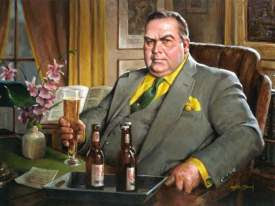


Having been originally published in 1938, Too Many Cooks, portrays the state of race relations in West Virginia at the time. Racism, replete with the most offensive racial slurs, is in evidence here. However, both Wolfe and Archie are shown to be enlightened; all their interactions with the mostly black service staff are on equal and respectful terms. If anything, Wolfe is the least tolerance of those white “officials” who express racism.

More to the point, in all things Wolfe’s attitude is one of mostly wanting to be left alone. He hates to waste his time on anyone, no matter their race or color, unless they are a paying client or one of the suspects he must interview to unravel the puzzle. Race is irrelevant to Wolfe in that regard.

One of the challenges of reading Too Many Cooks is that, as the title suggests, there is a huge cast of characters, thus many, many suspects. If you do dive into this novel, as I hope you will, don’t go crazy trying to keep everyone straight. Rex Stout, through his mouthpiece Archie Goodwin, does an excellent job of reminding you of just enough to keep tabs on who is who, and why he/she might have motive to kill the victim.

So to sum up. . . Too Many Cooks offers up the following:

Wolfe as a fish out of water.

Accurate portrayal of race relations in the South, with Wolfe being an equal opportunity pursuer of the guilty.

A slue of suspects, but Archie keeps them straight for us.

The usual hilarious interactions between Wolfe and Archie, as well as Wolfe’s magnetic persona that draws everyone towards him, like flies to the spider.

Enjoy!

Saturday, September 06, 2008

Star Trek (TOS) Book Review: The Pandora Principle by Carolyn Clowes


The Pandora Principle (1990) by Carolyn Clowes is predominantly an adventure designed to reveal Saavik’s origin. As such, it does a nice job of making sure the origin story is vitally important to the Spock-centric adventure of the Enterprise. This one is set just prior to the first Trek movie, the Motion Picture. Clowes novel effectively sets the stage for Kirk being relegated to a desk job, as he is at the beginnings of both movies. Cleverly putting the focus here on the Spock/Saavik dynamic, the author sets a brilliant trap for Kirk, having him out of the way, locked in vault for most of the novel.

Saavik’s origin, as told here, held my attention for the most part. (I seem to recall a different Saavik origin from DC Comics.) I felt that Clowes used the technique of withholding information a bit too often and for too long, I suppose in an attempt to build suspense. Personally, I find action oriented stories to be more suspenseful when the eminent danger for the main characters is the cause of tension, not something unknown and unexplained that is lingering out there somewhere. Probably Clowes heavy reliance on that approach was my biggest complaint.

The Spock/Saavik relationship was quite moving at times, with excellent bits of comic relief. In particular, I loved the conversation when Spock explains Pon-far to Saavik and further, her reaction to the tale that is “Amok Time.” Saavik plays the role of fresh audience, reacting with such abhorrence for how Spock’s betrothed treated everyone involved. Mainly through their interaction we get a glimpse at how Spock might have been as a parent. His long suffering and patience are completely in character. And it’s only one such as Spock that can tame the wild beast that Saavik seems to be when he finds her.

The new (unofficial) Romulan weapon was quite frightening, a virus that instantly consumed all oxygen. I was delighted that Dr. McCoy out-sciences and out-logics Spock in coming up with the antidote.

McCoy also gets the funniest line in the novel, “What am I saying? I just told the Big Bad Wolf to go cheer up Little Red Riding Hood!”

Friday, August 01, 2008

Reader's Response: "Pump Six" by Paolo Bacigalupi


Reader’s Response: “Pump Six” by Paolo Bacigalupi
from Fantasy & Science Fiction September 2008


The first person narrator, Alvarez, has troubles at home. He and his wife Maggie are trying to get pregnant, and Maggie doesn’t seem to be thinking too straight as she uses a lit match to locate a gas leak.

Alvarez has troubles at work, the sewage treatment plant for all of New York City. His fellow employees do no work and simply hang out and bicker all day. When an equipment problem comes up, they call Alvarez to fix it, if they think to even call Alvarez at all. In the course of the story, Alvarez comes to discover that the whole sewage treatment system is on the brink of complete collapse due to lack of maintenance over the course of one hundred years.

The world described in the story is one that is winding down. It appears that human beings may be de-evolving into new hermaphrodic, pack-like race called trogs that does nothing except hang out on the streets and have orgies. Alvarez worries that if he gets his wife pregnant their baby may end up being one of these trogs. Various other descriptions of the water, the lack of availability of certain consumer products (such as bacon), the breakdown the of the university system at Columbia (the students spend all their time on the quad in the nude), all suggest a future of social and genetic decay caused by environmental pollution.

Although the vision of things breaking down is depressing, I found the narrator’s voice to be engaging enough to maintain my empathy and interest. He’s a hard worker, thinks of the needs of others before himself, and endures the company of idiots for the sake of making a living.

My only complaint was some of the repetition of Alvarez’s worries and concerns. I guess the cycles of his griping about his co-employees (notice I don’t call them co-workers), about trying to get Maggie pregnant, and about how he’s stuck with the responsibility of being the only responsible fix-it person in sewage management, are intended to add realism. We all do tend to repeat ourselves when it comes to our everyday complaints. However, I would have preferred a bit of trimming on these points to make the story more concise.

“Pump Six” is an excellent example of the range of science fiction that is being published today. Anyone who thinks the genre is still only about space men and time travel hasn’t been reading the genre in ages. Even so, I would have never expected a story about future sewage treatment, yet it was fascinating and frighteningly plausible.

Bacigalupi’s story highlights the slump in human ingenuity and thus in turn society’s infrastructure that we all witness right here and right now. Food contaminated with E. coli bacteria, bridges collapsing, cranes falling: we face system failure all the time. Who doesn’t fear genetic mutations due to the poisons we have pumped into our environment?
Well, maybe those who are ceasing to think, which is the bigger horror Bacigalupi has illuminated here. There are those we encounter daily at work, in our schools and universities, and in our government who seem to be a thoughtless and ambitionless as Alvarez’s co-employees and as the trogs in the streets. One wonders at times if we are seeing the inevitable decay of our species.

Yet there are glimmers of hope, as Bacigalupi portrays in the final pages of the story. Alvarez appears to be a human with the ability to grow and learn, so all is not lost. There must be others.

I forced myself to look at the good things. People were still out and about, walking to their dance clubs, going out to eat, wandering uptown or downtown to see their parents . . . Lots of things were still working . . . I couldn’t let my myself wonder if that baby was going to turn out like the college kids in the quad. Not everything was broken.
As if the prove it, the subway ran all the way to my stop for a change. (41-42).


Even though most of the conflicts in the story remain unresolved, the tale ends on a tone of hope, suggesting we might be able to fix some of the problems we are creating for ourselves. But we need a few more good men, like Alvarez, who are willing and able to keep thinking to pull us out the muck. I hope they’re out there.

Friday, May 13, 2005

Mr. Fantastic, Machiavellian Superhero

Reviewing Fantastic Four: Authoritative Action by Mark Waid & Howard Porter (Collecting Fantastic Four #503-508)

First I’ll admit my biases:

1. I have been a fan of Fantastic Four comic since the late 70s. I loved to read those “World’s Greatest Comics” reprints of the Lee/Kirby days on FF. I loved what John Byrne did with the series in the 80s. Sure, there have been hundreds of truly awful FF comics. But for the most part, I am predisposed to enjoy their tales.

2. Mark Waid made a great positive impression on me when I encountered him in the flesh at the Baltimore Comic Con 2004. He struck me as personable, funny, intelligent, thoughtful, and extremely knowledgeable about superhero trivia and lore. Having experienced his personality, I was strongly curious about his writing and expected something great.

Having said that I will tell you that Authoritative Action is a marvelous Fantastic Four story! It begins after the defeat of Dr. Doom. The FF are attempting to hold together peace and order in Latveria, the country Doom ruled as a malevolent dictator. Rapidly one realizes that a parallel is being drawn to the U.S. effort to keep the peace in Iraq after toppling Saddam.

Reed Richards, Mr. Fantastic, is not his usual self. One side of his face has been horribly disfigured during the battle with Doom. The interior wounds are even worse.

Ben (Thing) : I think this Doom thing really messed ya up, Reed. I don’t mean th’ scar.

Reed is shown to be filled with fear and rage, mostly directed at the late Dr. Doom. His inner turmoil drives him to take control of the situation with Machiavellian means.

Reed (Mr. Fantastic) : We keep accomplishing half the job. We beat Victor, but we don’t clean up after him. And only we can. Not the U.N. inspectors. Not some Latverian burgomeister in stockings and a tweed hat. This room’s defenses would have cut them in half.

Reed declares himself the new leader of Latveria, claiming this is a temporary measure to hold things together and to prevent any other countries from scooping up Doom’s inventions and armaments. However, he resorts to manipulation and dishonestly toward the team as a shortcut to reaching his goals.

For example, at one point, Reed conceals from the team that he has taken control of the Doombots. When Johnny and Ben uncover a resistance group that is forming to oppose the Fantastic Four, Reed sends the Doombots to attack the clandestine group. Johnny and Ben rise to the defense of the rebel Latverians, doing their best to hold back the Doombots. Later they come to find out Reed sent the attack fully expecting his partners to fight it back. As a result, Reed hoped the people who come to see the FF as the heroes, and not the adversaries Doom made them out to be. In effect, Reed was manipulating the situation in order to generate dramatic propaganda.

Reed: Once word spreads that you saved them from the last of Victor’s rampaging enforcers, that should cement our popularity. Well done. That was the final asset left to be stripped from Doom: his subjects’ allegiance.

Ben: So we wuz part of a show? A set-up?

Johnny (Human Torch) : You’re out of control! Where to you get off playing us? Answer me!

Meanwhile, the governments of the world put pressure on the United States to remove the FF from power, arguing that it appears the FF are U.S. agents taking power unrightfully. Particularly the Hungarian government claims that Latveria belongs under their control, since Doom forcibly annexed it from them years ago. Even though Nick Fury attempts to stick up for what Reed and the others are trying to do, military force is sent to remove the FF from power. Fury attempts convince Reed to walk away before the battle begins, but Reed will not bend. He has a farther reaching plan that he’s concealed from everyone.

The resolution of the plot was a shocker to me. By the end, the FF incur severe causalities, not at the hands of the military, but in battle against Dr. Doom. Yes, that’s right: Doom resurfaces and does some horrific damage. And Reed’s manipulation and secrecy unintentionally has everything to do with Doom’s opportunity to attack. The ending is brutal and tragic. There is a extreme bit of “Gift of the Magi” O’Henry twist. Reed’s sacrifice for his family and their willingness to risk for him ends up in high sacrifice all around. I found myself shaking my head in surprise and horror.

The story is not entirely dark. Waid has a wonderful sense of the banter between the team members. Comic relief is offered in regular doses.

Johnny: Aren’t Doombots normally a little more formidable than this?

Ben: “This one’s too tough! This one’s not tough enough!” Ain’t you ever happy? Check it out, Goldilocks--this one’s just right!

It’s also nice to see that the last page ends with an absurd announcement from Reed. Waid demonstrates his mastery of tone and pace. I closed the book with anticipation of the next collection.

By the way, the art work of Howard Porter and Norm Rapmund is quite nice too. The Thing’s facial expressions are highly emotive, perhaps the best they’ve been drawn. Not once did I find the art lacking in detail or storytelling ability. ‘Nuff said! Check it out!

Friday, May 06, 2005

The Significance of Pacing in Left Behind

Warning: This entry contains SPOILERS for the novel Left Behind by Tim LaHaye and Jerry B. Jenkins. If you have yet to read Left Behind and think you might, I suggest coming back to this after you have done so. Also note that while this write up does concentrate heavily on my disappointments, ultimately I found the novel inspirational, suspenseful, and intriguing. I highly recommend it!

Over the last few days, I read the first in the Left Behind series by Tim LaHaye and Jerry B. Jenkins. The strength of the novel is its engaging characters and fascinating situations. However, I did encounter moments of disappointment in this novel related to pacing. Particularly the last quarter of Left Behind suffers from forced plotting at high velocity. Things happen so fast that the author’s controlling hand is exposed and suspension of disbelief is broken.

The speed at which the Antichrist rises to power is too quick. The problem isn’t the lack of means on the part of the Antichrist, since there are supernatural forces and fulfillment of prophecy at work here. The difficulty is in the duration of time as portrayed in the novel. We are asked to believe that all the events, personalities, logistics, and apparatus involved in his rise to power would fall into place in lockstep and at the pace of a manufacturing die cutter. Within a matter of days after the disappearances, Carpathia, the Antichrist, has gone from being a nobody to the leader of the U.N.. He has also maneuvered the world-wide media, the governments of the world, and the infrastructure of the U.N exactly where he wants it. Given the climatic scene where he demonstrates his hypnotic powers and reveals his ruthless bent for evil, we can see how he accomplished it, but it just happens too fast. The supporting sub-structure of power would not coalesce that quickly. There’s not enough time for the cause and effect reactions to pan out.

Additionally, there is the immediate domino effect of what happens to Buck‘s career in news reporting. Since Carpathia effectively makes it appear that Buck was not present at an important meeting and press conference, Buck’s boss comes down hard on the reporter, removing him from the managing editor position and trumping him back down to a staff writer role. Not only that but the boss is so outraged and distrustful of Buck, he insists that Buck be moved to Chicago. The boss seems to have gotten amnesia about Buck’s previous skills and performance. Up to this point, we haven’t seen anything to suggest that Carpathia has a direct influence over Buck’s boss, so we can only guess that his outrage and distrust is based on his own reaction to Buck being apparently absent from the media coverage. This about face of the character from high admiration and trust of Buck to complete condemnation strikes me a contrived device of the authors to maneuver Buck where they want him, in Chicago, near the other Christian heroes who are plotting their resistance against Carpathia. And come to think of it, I’m left to wonder why Carpathia would stop at having Buck discredited if he suspects Buck might oppose him or even be ambivalent. A number of people, including a fellow reporter, have already been murdered to protect Carpathia’s unquestioned rise to power. Why not Buck too?

On the flipside, the authors were controlled and steady in their depiction of both Chole’s and Buck’s process of coming to a decision to about Christ. Neither character’s acceptance of the gift of salvation seemed rushed or forced. Both characters are shown to be intellectual and skeptical about the situation and Rayford’s offered explanation/solution. Neither wants to jump into a life of faith without having thought about it awhile. The overall message that comes across due to the pacing of these scenes is that Christians should never jump to conclusions that their witness is not having an effect on those they witness to. This is illustrated in Rayford’s internal thoughts about how Buck is responding his witness. Rayford jumps to the conclusion that Buck is offended and/or bored, when in fact, he is stirred. Often it does take time for people to sort through their biases and assumptions, their intellectual criteria and pride. Don’t expect an immediate response. And don’t jump to the conclusion that you are not getting through.

I’m guessing that the authors of Left Behind had to make an artistic choice about where they could slow down and speed up the pace. The novel is after all 468 pages long (granted with very wide margins). More pages and a slower pace at the end probably wouldn't have improved it over all. Perhaps it makes complete sense for them to have stretched things out during the exploration phase for Chole and Buck, emphasizing the realism of their conversions. The maneuverings in the last 25-50 pages are less significant because they are simply setting up the stage for the next phase of the series. I’d much rather have them rush the aspects they did rather than rush the dramatization of the conversions. The realism of the conversion process has much more significance for Christian readers and may in fact help encourage us all to be more persistent and patient in our witness for Christ.